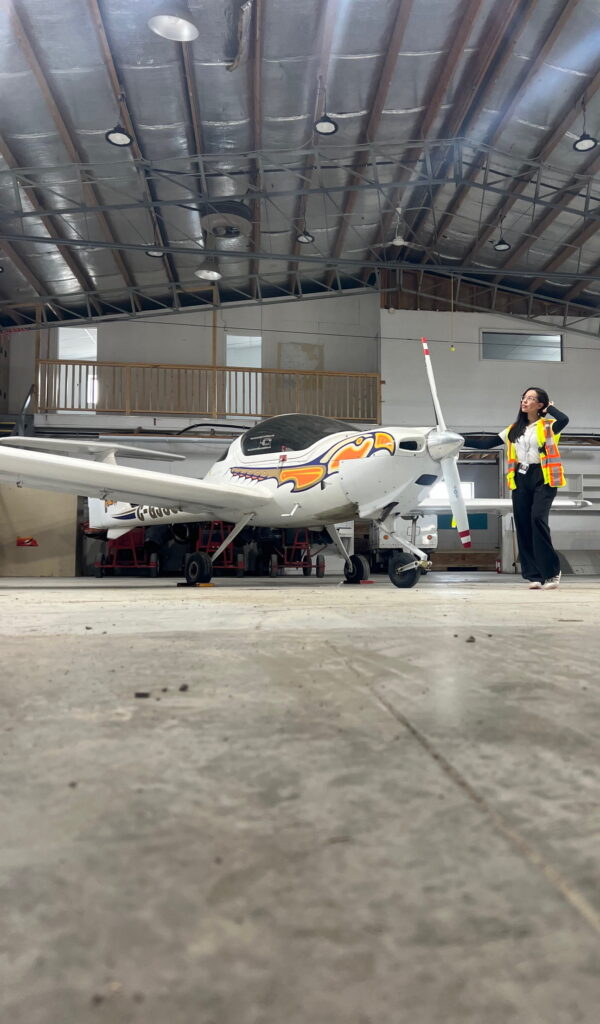

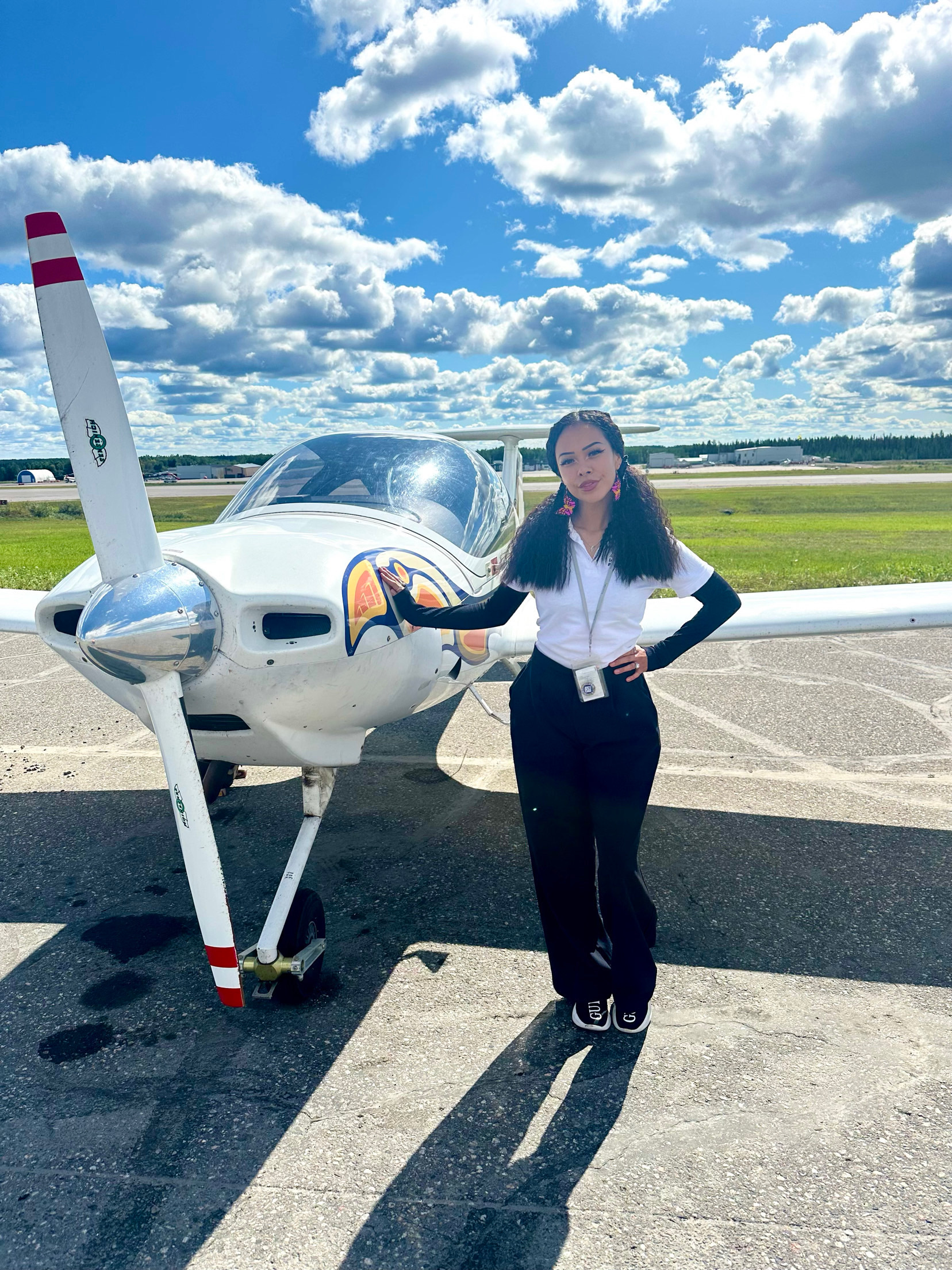
From a young age, Siksika Nation youth member, Tyniva Eagle Rib, dreamed of becoming a
pilot. Often, however, she was told it was impossible. “I was always told I couldn’t do it; I
wasn’t smart enough or tall enough, and it was too much math,” she says. Discouraged,
she set the dream aside and pursued other career paths before realizing that they are not
where her passions lays. Eventually, with the help of her family and a trip to Europe, her
determination to become a pilot spoke louder than those who doubted her and, in 2025,
obtained her Private Pilot’s License (PPL) at the Moncton Flight College in New Brunswick.
Now, she is on her way to become an airline transport pilot.
When Tyniva was 13, a family trip to Germany changed everything for her. Being there, she
felt welcomed as an Indigenous person. She expressed that, “growing up in Canada, I hated
myself. I didn’t want to be native. All I wanted to do was be white, so, being able to go to
Europe and feel welcomed and feel good in my skin, it completely changed everything for
me.” She hopes to bring that to other kids by becoming a pilot. “If I’m able to fly a plane,
then eventually, I’m able to buy a plane. Then I can build a runway in Siksika and I can do
discovery flights, have enough income to gift families a trip and they don’t have to pay for
their flights or their hotels and meals. That’s the dream,” Tyniva says. What solidified her
dream was working with Janice Doore, who brought her into the Siksika Support Centre to
run youth mentorship programs. There, she learned the struggles that youth face and by
becoming a pilot, hopes to expand their minds and dreams—to show them that anything is
possible.
Currently, Eagle Rib is in the Atik Mason Indigenous Pilot Pathway Program, based in
Thomspon, Manitoba and Rankin Inlet, Nunavut. In 2024, before obtaining her PPL, Tyniva
completed a program called West Program by Elevate Aviation, a women’s employment
skills training program, giving her the foundation to work in aviation. There, she obtained
her radio operative certificate for aeronautics. Soon after, through a Facebook Ad her mom
sent, she applied to the Indigenous Pilot Pathway program and navigated a demanding
four-month application process that included multiple interviews and essays. “I honestly
thought it was a scam at first,” Eagle Rib laughs. Eventually, Tyniva got the good news that
she was accepted in February 2025.
Training at Moncton Flight College quickly showed Eagle Rib that becoming a pilot involved
far more than learning how to fly an aircraft. Students are required to master air law,
navigation, meteorology, aircraft engine systems, aircraft theory of flight, aircraft flight
instruments, flight operations, and human factors. The accelerated program allowed her to
earn her PPL in just eight months, a process that often takes much longer. Looking back on
the academic demands, she laughed and said, “You have to learn how to be a lawyer, a
doctor, a meteorologist, and a pilot all at the same time.” Some of the biggest hurdles came
while preparing for the rigorous Transport Canada exams. Navigation was initially one of her
most difficult subjects, and she often questioned whether she could succeed. However,
with support from her family and mentor, Atik Mason, she pushed through. Atik reminded
her, “If these exams make you feel like you’re losing your mind, you’re human.” The
encouragement helped her persevere through months of studying and intensive testing.
That perseverance paid off when she achieved one of her proudest accomplishments:
earning a 94 percent in navigation, the subject she had struggled with the most. Academics
was not the only challenge Tyniva faced. Living away from home, adapting to life in
Manitoba and New Brunswick, managing financial pressures such as a lack of proper
training equipment, and navigating a male-dominated industry all tested her confidence
and was overwhelming. “There were so many times I called my mom and wanted to quit,”
She recalls. Eagle Rib remembers that when she first started the program, she was
extremely excited; however, being one of the few Indigenous girls in a male-dominated
field, she was taken less seriously and faced constant belittlement. She shares, “they
barely let me fly the plane, they would question my knowledge, and I never ever saw them
questioning my male classmates’ knowledge.” Through it all, her family, fiancé, and Atik
Mason remain her strongest support system, encouraging her to keep pursuing the dream
she hashad since childhood.
Today, Tyniva Eagle Rib is continuing her training toward her commercial pilot’s license,
multi-engine and instrument rating license, and her airline transport pilot’s license, with
hopes of one day flying for Canadian North. “I really do want to work for Canadian North for
the rest of my career. That’s where I see my home being, especially because I want to get to
know the indigenous peoples in the north.” Tyniva also hopes to also bridge the gap
between Indigenous communities in the North and Alberta and grow a partnership between
each other. “We’re stronger together. I see a lot of potential in aviation and the way that it
can help Siksika.”
Tyniva Eagle Rib shares words of encouragement for youth who have the same dream of
one day becoming a pilot: “Go for it. Even just getting a job at the airport or looking into
different seminars—I truly think that it’s worth it. I wanted to let other youth know that it’s
not such a far dream and to not be discouraged, like if you’re short, if you’re tall, if you’re
bad at math, like go for it. I was horrible at math, and I hated math in high school, but this
type of math is not the same. It’s honestly really fun. I really want there to be more pilots in
Siksika and I want to be someone from Siksika telling other kids that you can be a pilot and
that it’s not so out of reach. If they’re wanting to pursue and if they do get into this career,
100% reach out to me because having someone to talk to that’s been where you are at, it’s
so beneficial. If I didn’t have my mentor, who’s also a First Nations man, I wouldn’t be
where I’m at. I wouldn’t have completed my PPL. Just know you belong there and don’t be
afraid to take up your space. Shine and be you. That’s something I wish I could have told
myself last year, but that’s something that I want everyone to know.”