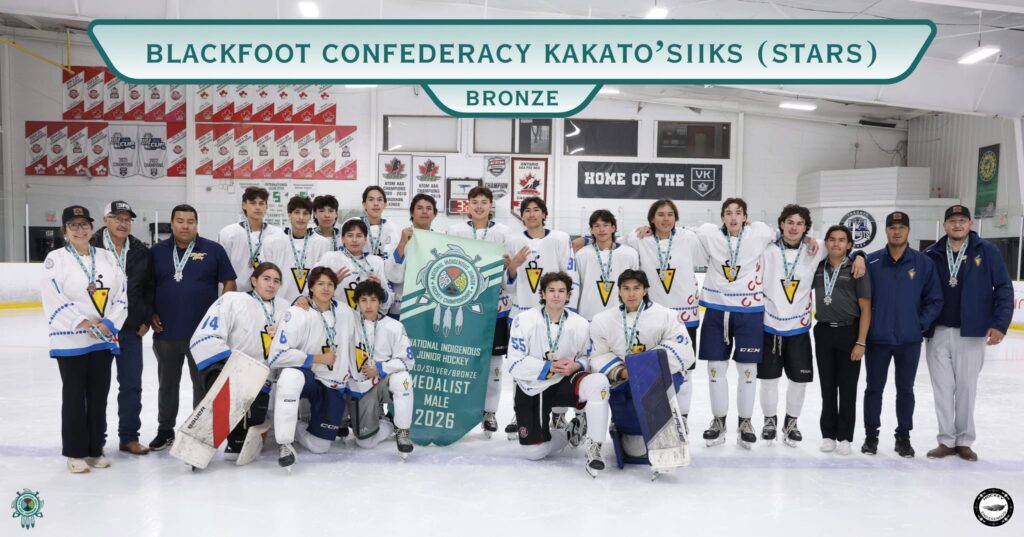

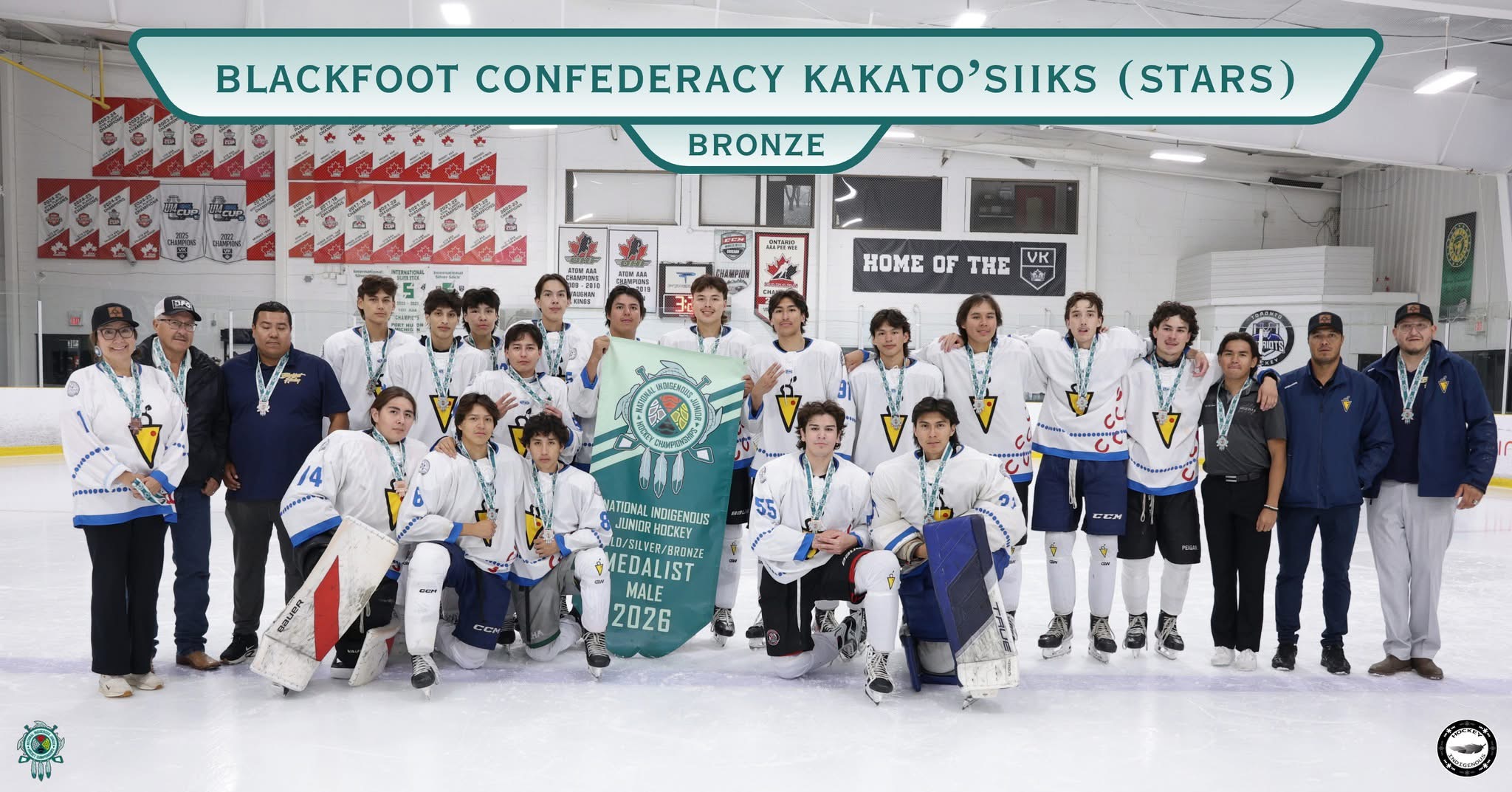
The Kakato’siiks Blackfoot Confederacy U21 hockey team made a memorable first appearance at the National Indigenous Junior Hockey Championship, earning a third-place finish while representing the Blackfoot Confederacy on a national stage.
The team brought together U21 players from across the Blackfoot Confederacy, creating an opportunity for young Blackfoot athletes to compete together under one banner for the first time at the national championship.
For General Manager Alayna Doore, forming the Kakato’siiks was about more than building a competitive hockey team.
“The Blackfoot Confederacy had never before come together as one team to compete at this level nationally,” Doore said. “We knew there was a tremendous amount of talented U21 hockey players throughout our Nations, and we wanted to create an opportunity for them to come together, represent the Blackfoot Confederacy, and showcase that talent on a national stage.”
Preparing for the championship required a major effort from players, staff, families and supporters. With only three months to organize the team and prepare for the tournament, Doore said there were many details that needed to come together.
“Attending a national tournament of this calibre is very expensive, and we had only three months to bring everything together,” she said. “There were many moving pieces involved in ensuring our athletes could travel, compete and have a successful experience.”
Support came from businesses, organizations, families and community members who contributed financially or offered encouragement and prayers.
Doore said some parents and family members also travelled to support the team in person.
“The support was heartwarming,” she said. “Seeing so many people come together behind these young men made us incredibly proud to be Siksikaitsitapi and motivated us to represent our people to the best of our ability.”
Going into the tournament, the organization wanted the players to compete hard while also appreciating the opportunity in front of them.
“Our expectation was for every player to give their best effort, represent themselves and their Nations with pride, and most importantly, enjoy the experience,” Doore said. “Opportunities like this are something to be cherished.”
Trainer and Equipment Manager Desmond Redcrow entered the championship with high expectations of his own.
“I am always going in with a championship or bust mentality,” Redcrow said. “I had high expectations based upon the type of group we had.”
Behind the scenes, Redcrow’s responsibility was to make sure the players had what they needed to focus on playing hockey.
“Basically take care of the boys,” Redcrow said. “Get the dressing room to feel comfy enough for them to perform well on ice.”
Redcrow described his experience at the championship as an enjoyable one. He also took pride in representing the Blackfoot Confederacy through his role as a trainer and equipment manager.
He said he was the only trainer from Western Canada at the tournament and noticed other trainers taking ideas from his equipment setup.
“It was nice to know I inspired them to invest more in their setup,” Redcrow said.
While the players came from different communities across the Confederacy, many already knew one another through hockey. Redcrow said the group was tight-knit, with some players having competed together for much of their hockey careers.
Doore said the organization also made a deliberate effort to strengthen those relationships throughout the championship.
The team used a holistic approach to wellness and team development, including team breakfasts, positive affirmations, team-building activities, mobility and recovery sessions, along with opportunities for the players to spend time together away from the rink.
“Those moments helped build trust and connection, and by the time they stepped onto the ice, they weren’t just individual players from different Nations—they were a team,” Doore said.
For her, seeing players from throughout the Blackfoot Confederacy come together was one of the most meaningful parts of the experience.
“It was incredibly empowering to see players from across the Blackfoot Confederacy come together and represent us as one team,” Doore said. “It gave us an opportunity to support these young men, showcase their talents and celebrate who we are as Siksikaitsitapi.”
The tournament also presented new challenges. Travelling and navigating Toronto were among the adjustments the group had to make, according to Redcrow, but the experience allowed the team to learn together as the championship progressed.
On the ice, the Kakato’siiks proved they could compete at the national level.
The team finished the championship in third place, bringing home a bronze medal in its first appearance.
“We hoped to compete for a medal, and to come home with bronze in our very first appearance was an incredible accomplishment,” Doore said.
She said what impressed her most was not only the athletic ability of the players, but also the character and values they demonstrated throughout the tournament.
“They represented their families, communities and the Blackfoot Confederacy extremely well,” she said. “More importantly, these young men became positive examples for the youth who will follow them.”
Redcrow was also proud of the finish but said the experience has given the team something to build on.
“We needed to experience it,” he said. “We would like to go back and bring home the championship.”
Representing Blackfoot people at the national level was especially meaningful for Redcrow.
“We were one of two teams from Western Canada but the only Blackfoot team there,” he said. “I made sure to represent us very well.”
For the organization, the impact of the tournament extended beyond the players who travelled with the team.
Doore recalled hearing younger Blackfoot boys say, “I want to be like them when I grow up.”
She said hearing those words showed the importance of creating opportunities and visible role models for the next generation.
“These young men demonstrated kindness, hard work, pride and integrity,” Doore said. “I hope younger Blackfoot hockey players can now see a pathway for themselves and know that they, too, can represent their Nations and the Blackfoot Confederacy on a national stage.”
Redcrow said he hopes the team’s success encourages more young athletes throughout Blackfoot country to pursue the same opportunity.
“I’m hoping this experience will inspire everyone in Blackfoot country to make the U21 team for the next coming years,” he said.
Doore also reflected on her own role as a female General Manager leading a U21 team at a national championship.
She said she hopes her involvement can show young people that they should not be afraid to pursue opportunities they believe in.
“Do not be afraid to follow your dreams,” Doore said. “We see you. We believe in you. Continue to work hard.”
For Kakato’siiks, the bronze medal represents an important beginning rather than an ending.
Doore said the organization is already preparing for the 2027 National Indigenous Junior Hockey Championship and hopes to continue building on the foundation established during the team’s first appearance.
“This was only our first chapter,” she said.
Doore thanked the players, coaches, families, businesses, organizations and community members who helped make the team’s first national championship possible.
“To everyone who supported us, contributed, encouraged us and kept us in your prayers—thank you,” she said. “We are eternally grateful.”